

Every Department Is Doing Its Own Thing — The Cost is Millions; The Risk is Worse.
Most health systems believe they have a physician staffing problem. What they actually have is a data fragmentation problem. Every department managing its own numbers is not just inefficient. It is expensive, and the exposure compounds every quarter.
Ask most health system executives how much they spend on physician staffing and recruiting, and you will get a number. Ask them how much they spend across every hospital, clinic, service line, and department, including every locum tenens agency contract, every search firm engagement, every conversion fee, and every hour of administrative time spent managing it all, and the room usually goes quiet. The reason is simple: in most organizations, nobody actually knows.
That knowledge gap is not an accident. It is the direct result of a decentralized staffing and recruiting model, in which individual hospitals, departments, and even individual medical directors engage agencies and search firms on their own, negotiate their own rates and terms, and process their own invoices. Each of those decisions may look reasonable in isolation. A department chief needs weekend hospitalist coverage, so she calls the agency recruiter who has been emailing her for months. A rural affiliate needs an OB/GYN, so it signs whatever contract gets a candidate on site fastest. But when these one-off decisions are multiplied across an entire health system, they compound into one of the largest sources of hidden cost, risk, and inefficiency in healthcare operations today.
The stakes are considerable and growing. The U.S. locum tenens market reached an estimated $9.6 billion in 2025 and is projected to hit $9.9 billion in 2026, driven by worsening physician shortages and rising patient demand. Roughly 85% of hospitals, medical groups, and other healthcare facilities use locum tenens physicians, and locum providers now serve as many as one in three U.S. patients each year. Against that backdrop, the difference between a coordinated staffing strategy and a fragmented one is no longer a rounding error, it is a material line on the income statement. This article breaks down where the money, the candidates, and the control actually leak out when staffing and recruiting are left decentralized.
Forfeiting the Power of Collective Spend
The most immediate and quantifiable cost of decentralization is the loss of purchasing leverage. A health system spending $15 million annually on locum tenens and search fees across twelve facilities is, from a vendor's perspective, twelve small customers rather than one large one, and it gets priced accordingly.
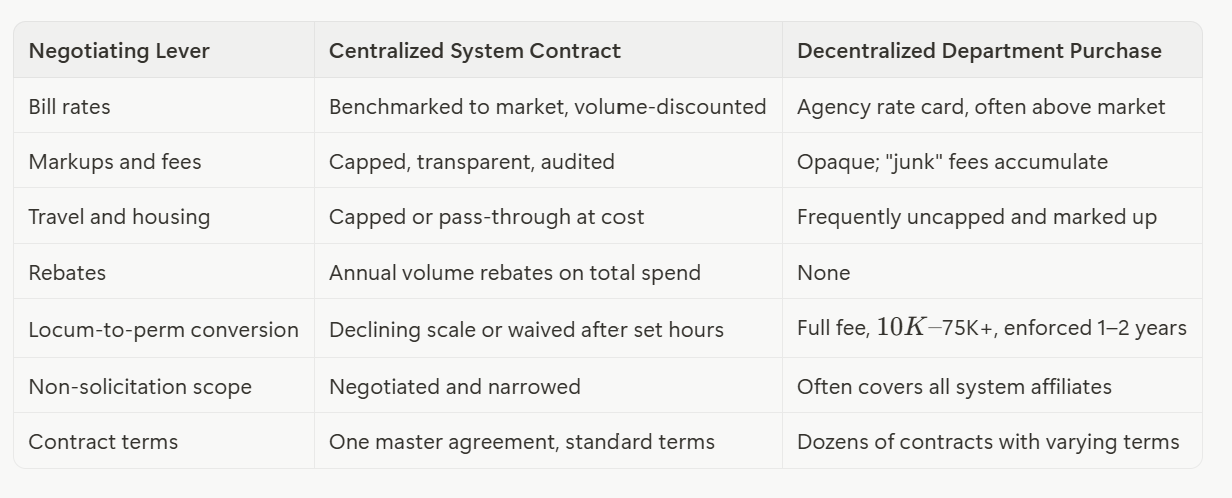
Staffing agencies, like any business, reserve their best economics for their biggest and most strategic clients. When spend is consolidated and contracted at the system level, the organization can negotiate meaningful concessions that are simply unavailable to a single department buying ad hoc coverage. These typically include volume-based bill rate discounts, capped or pass-through travel and housing expenses, reduced or tiered administrative markups, and volume rebates that return a percentage of total spend at year end. Vendor management experts note that simply auditing invoices and stripping out the "junk" fees that accumulate in unmanaged programs, seasonal surcharges, separately billed malpractice fees, marked-up travel, routinely yields cost savings of up to 10%. That is before any rate negotiation even begins.
Perhaps nowhere is the lost leverage more expensive than in locum-to-permanent conversion terms. When a locum physician works out well and the facility wants to hire them permanently, the agency charges a conversion or placement fee. These fees are substantial: typically, $15,000 to $25,000 for primary care, $20,000 to $40,000 for medical subspecialties, and $40,000 to $75,000 or more for surgical subspecialties. A system negotiating a master agreement can secure declining fee schedules, for example, full fee within six months, half at six to twelve months, and zero thereafter, or buyout clauses that waive the fee entirely after a defined number of worked shifts. A department signing an agency's standard paper gets none of that. It gets the full fee, often enforceable for one to two years after the physician's last shift, and frequently a non-solicitation clause covering not just the facility but every affiliate in the health system. In effect, a single department's signature can encumber the entire organization's ability to hire.
Rate Chaos: Paying Different Prices for the Same Physician Hour
Decentralization does not just mean paying more, it means paying inconsistently, which is its own category of waste. Workforce management firms that audit hospital locum spend report a striking pattern: a single facility will frequently hold multiple contracts with the same vendor at different rates and terms, sometimes even within the same department. Multiply that across a multi-hospital system, and it is entirely common for one campus to pay $250 per hour for a hospitalist while a sister facility twenty miles away pays $310 per hour to the same agency for the same coverage.
This happens because each buyer negotiates from a position of urgency and isolation. Nobody is benchmarking against what the organization already pays, because nobody can see what the organization already pays. As one CFO-focused analysis put it, many organizations have no insight into how many locum vendors their individual facilities and departments are even using, let alone what each one charges. Agencies, understandably, are not going to volunteer rate reductions when a client is overpaying. Without a market rate analysis and a consolidated view of spend, rate variance quietly persists year after year, and standard agency rate cards that escalate annually go unchallenged.
There is a compliance dimension to rate chaos as well, discussed further below: when the same organization pays widely divergent rates for equivalent physician services, documenting that every arrangement reflects fair market value becomes considerably harder.
Non-Standardized Processes and Gross Operational Inefficiency
Beneath the pricing problem sits a process problem. In a decentralized model, every location develops its own way of requesting coverage, vetting candidates, executing contracts, onboarding providers, approving timesheets, and paying invoices. None of these workflows benefit from shared learning, shared templates, or shared technology. The result is gross inefficiency of a kind that rarely appears on any budget line but consumes enormous organizational capacity.
Consider what this looks like in practice. Legal reviews the same boilerplate agency agreement fifteen separate times a year because fifteen departments each signed a slightly different version. Credentialing offices at different facilities independently collect, verify, and file the same physician's licenses, DEA registration, board certifications, and malpractice history, even when that physician floats between sister hospitals. Timesheet approval, expense reimbursement, and invoice reconciliation follow different rules at every site, so nothing can be automated and no one can be cross-trained. Credentialing alone typically takes 60 to 90 days under normal conditions and can exceed 120 days when processes are handled sequentially rather than in parallel, and fragmented organizations, lacking a standardized playbook, land on the slow end of that range far more often. Every extra week of credentialing delay is a week of vacancy cost, which, as covered below, is measured in the tens of thousands of dollars.
The inefficiency compounds because the fix for slow, inconsistent processes in a decentralized organization is usually more people doing manual work, rather than standardization. Industry data shows the market moving decisively the other way: 47% of advanced practice staffing revenue now flows through managed service provider (MSP) or vendor management system (VMS) arrangements, precisely because hospitals are demanding faster placements, stronger compliance, and better workforce visibility from a single standardized pipeline.
Duplication of Work Across the System
Closely related to process inconsistency is outright duplication, multiple teams unknowingly performing identical work in parallel. In a decentralized system, three facilities may simultaneously run separate searches for the same specialty, each paying its own sourcing costs, advertising spend, and search firm retainers. Each search independently incurs $2,000 to $15,000 in job board and advertising costs, $2,000 to $8,000 in candidate travel and site visit expenses, and search firm fees typically running 20% to 25% of first-year compensation. Each facility separately negotiates with agencies that another facility already has under contract. Each maintains its own vendor files, its own reference checks on the same agencies, and its own institutional knowledge that evaporates when a practice manager leaves.
The candidate-facing duplication is just as costly. The same locum physician may be credentialed three separate times by three facilities in the same system, with each credentialing cycle costing $3,000 to $10,000 in direct expense plus staff time, and each cycle delaying revenue-generating shifts. Meanwhile, back-office teams at every site are processing their own stack of agency invoices, chasing their own timesheet discrepancies, and building their own spreadsheets to answer the same basic question: what are we spending, and with whom?
The Organization Competing Against Itself for Physicians
Of all the costs of decentralization, this one is the most corrosive, because it damages the organization in the candidate market itself. When multiple facilities or departments recruit independently (often through different agencies) it is only a matter of time before they end up pursuing the same physician.
The failure modes are predictable and, to candidates, glaring. A physician receives outreach from two different agencies about two openings that turn out to be at the same health system, at different offered rates, instantly teaching the candidate that the system's rates are negotiable upward and inviting agencies to shop the candidate internally for the best price. Two facilities in the same system extend competing offers to the same candidate, bidding against each other with the organization's own money. A candidate rejected by one facility's process is approached weeks later by a sister facility with no knowledge of the prior interaction, presenting a disjointed and amateurish employer brand. In the worst cases, an agency places the same physician's profile with multiple entities inside one system and collects the fee from whichever bites first, at whichever rate is highest.
In a market where federal projections show physician shortages deepening through 2037, with gaps as severe as 36% in vascular surgery, 32% in ophthalmology, and 27% in family medicine, and where 55% of physicians report high stress or frequent burnout, candidates have abundant options and little patience. Physicians talk to each other, and a health system that appears disorganized in its recruiting is signaling how it will treat providers after they sign. Internal competition does not just inflate the price of a single hire; it degrades the organization's standing with every candidate who witnesses it.
Compliance Gaps: The Risk Nobody Budgets For
Decentralized staffing does not merely cost money, it creates regulatory exposure that can dwarf any staffing budget. Three areas deserve particular attention.
Exclusion screening. Every provider and staffing vendor must be screened against the HHS Office of Inspector General's List of Excluded Individuals and Entities (LEIE), the GSA's SAM database, and applicable state exclusion lists. Employing or contracting with an excluded provider (even unknowingly, even through an agency) exposes the organization to civil monetary penalties and repayment of claims associated with that provider. When each department manages its own agencies, there is no single point of accountability ensuring every agency actually performs monthly screening, and no audit trail proving it. One facility's diligent process provides zero protection against another facility's oversight.
Credentialing and malpractice verification. Locum malpractice coverage varies significantly: some agencies carry occurrence-based policies, others carry claims-made policies where tail coverage, which can cost anywhere from $5,000 for primary care to $450,000 for neurosurgery, may or may not be included. A centralized program verifies coverage type, limits, and tail provisions against a single standard before any provider works a shift. In a decentralized model, whether that verification happens depends on which facility signed the contract and who happened to read it. A gap discovered after an adverse event is a gap discovered far too late.
Fair market value and regulatory documentation. Physician arrangements are subject to the Stark Law and Anti-Kickback Statute, which generally require that compensation be consistent with fair market value, commercially reasonable, and documented in writing. A system that pays materially different rates for equivalent physician services across its facilities (with no centralized benchmarking or rationale) has a harder time demonstrating that any given arrangement reflects fair market value rather than local improvisation. Standardized, benchmarked rates are not just a cost control; they are a compliance defense.
Death by a Thousand Invoices: The Back-Office Burden
Every additional agency relationship is a stream of invoices, and in a decentralized model those streams multiply without limit. A system working with thirty agencies across ten sites can easily process hundreds of locum invoices per month, each in a different format, each with different line items, different expense documentation standards, and different payment terms ranging from due-on-receipt to Net 45.
The accounts payable consequences are predictable. Staff spend hours reconciling invoices against timesheets that were approved in different systems (or on paper). Discrepancies (a marked-up flight here, an unapproved overtime hour there) are caught inconsistently or not at all, which is precisely how the "junk" fees that invoice audits later uncover become embedded in spend. Duplicate payments and missed early-payment discounts slip through. And because spend data lives in dozens of formats across dozens of vendor relationships, finance cannot produce a reliable answer to basic questions about contingent labor spend without a weeks-long manual exercise. Consolidating procurement and vendor management under a single program or platform directly reduces this administrative burden while providing visibility into program usage and cost, which is exactly why the burden persists wherever consolidation has not happened.
The Costs That Do Not Show Up on Any Invoice
Several further consequences of decentralization deserve mention, because they quietly amplify everything above.
No data means no workforce strategy. A system that cannot see its aggregate staffing spend, fill rates, time-to-fill, and agency performance cannot plan. It cannot identify that one service line has been running on locums for three years at a 30% to 60% premium over permanent compensation and would be cheaper to fix with a targeted permanent recruitment investment. Vendor-neutral VMS data is what allows leadership to translate utilization patterns into decisions about where to prioritize permanent hiring, and decentralized organizations simply do not have it.
Vacancy costs compound while fragmented processes crawl. A vacant physician position costs a hospital an estimated $5,000 to $10,000 per day in lost patient revenue, downstream referrals, and ancillary volume, and physicians on average generate several million dollars in annual revenue for their affiliated hospitals. When decentralized processes add even two or three weeks to sourcing, contracting, or credentialing, the vacancy cost alone can exceed $100,000 to $200,000 per position, dwarfing whatever the department thought it saved by handling the search itself.
Turnover becomes more likely and more expensive. Disjointed recruiting produces worse-fit hires, and inconsistent onboarding produces worse first-year experiences. With total physician turnover costs estimated between $1.8 million and $2.8 million per departure when recruitment, ramp-up, and lost revenue are counted, even a small increase in early attrition attributable to a chaotic recruiting experience is enormously expensive.
Vendor accountability disappears. When no one owns the agency relationship at the system level, no one tracks which agencies deliver quality candidates on time and which submit unvetted profiles and dispute every invoice. Poor performers keep getting orders from whichever facility does not know better.
Putting a Number on It
The individual leakage points are easier to grasp when assembled into a single view. The table below illustrates the annual exposure for a hypothetical mid-sized health system with $15 million in annual locum tenens and physician recruiting spend across ten facilities, using the ranges documented above.
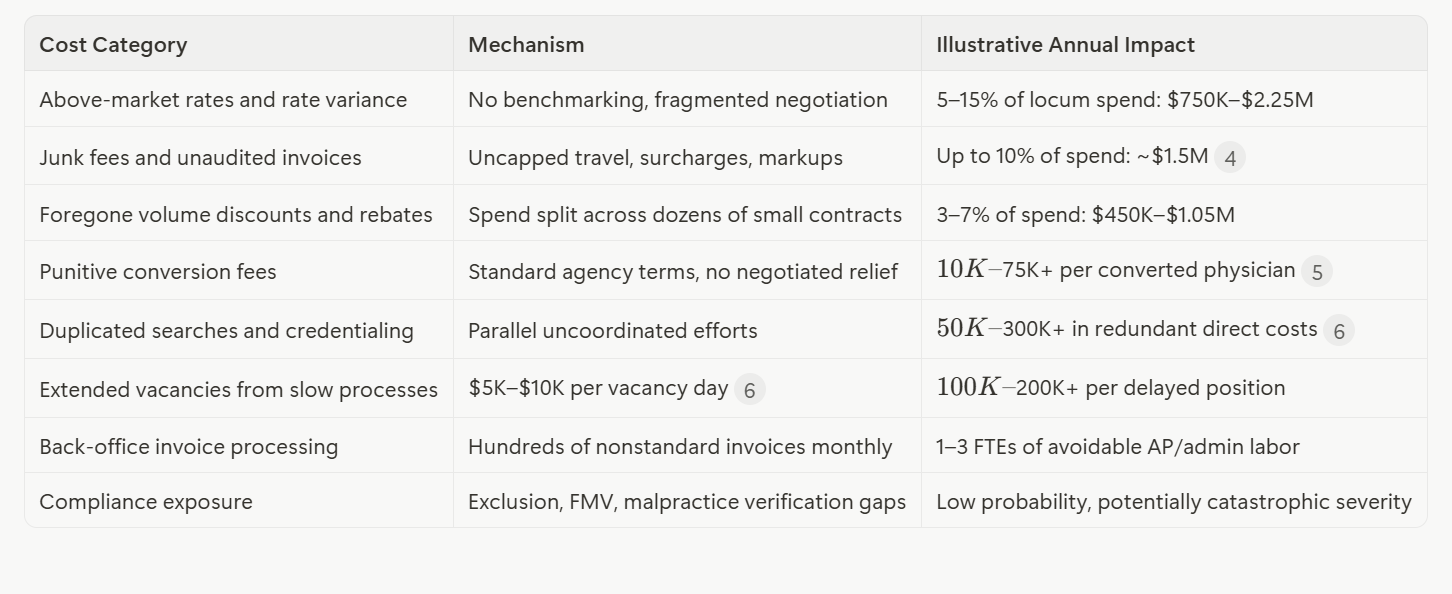
Even taking the conservative end of each range, a decentralized $15 million program plausibly leaks $2 million to $4 million per year in identifiable, recoverable value, before assigning any dollar figure to compliance risk, employer brand damage, or the strategic cost of flying blind on workforce data.
The Path Forward: Centralize the Leverage, Not Necessarily the Decisions
The remedy is not to strip hiring authority away from clinical leaders who know their departments' needs best. Local leaders should absolutely drive decisions about who to hire. What must be centralized is the commercial and administrative machinery around those decisions: a single master agreement structure with standardized terms across all approved agencies, system-negotiated rates benchmarked against current market data rather than legacy rate cards, uniform locum-to-perm conversion and non-solicitation terms, one credentialing and compliance standard with verifiable exclusion screening, consolidated invoicing through a single platform, and a shared candidate record so the system never unknowingly competes against itself.
This is the model the market is already converging on, nearly half of advanced practice staffing revenue now flows through MSP or VMS arrangements, and the organizations that adopt it consistently report lower cost per provider, faster fills, and cleaner compliance . The physician shortage is not going away; federal projections extend it through at least 2037 . Hospitals and health systems will be buying flexible physician labor at scale for the foreseeable future. The only real question is whether they buy it as one sophisticated customer with full visibility and full leverage, or as a loose federation of small buyers paying retail, over and over, in every department, at every location.
Rate This Article
Click a star to rate
If any of this resonates — or you want to pressure-test these frameworks against your own data — I'm happy to connect. No pitch, just a conversation.
Schedule a Meeting →