

Stop Blaming the Talent Shortage. Your Credentialing Process Is the Problem
Hospitals are losing physician candidates they spent months recruiting, not because of better offers or competing health systems, but because of their own credentialing process. In an era where the IMLC can issue a multi-state medical license in under a week, the slowest and most destructive part of the physician pipeline is the hospital's own back office. This article examines why, what it costs, and how the hospitals winning the talent war have engineered their way out of it.
You did the hard work. You built the passive pipeline. You identified the right physician candidate months before the vacancy was even posted. You nurtured the relationship, navigated the compensation conversation, addressed the spouse's career concerns, and secured a signed offer letter. Your team celebrates. The requisition is marked "filled." The CMO sends a congratulatory email.
And then the candidate enters the black hole of hospital credentialing.
Ninety days later, the physician is still waiting for privileges. The medical staff office is waiting on a primary source verification from a training program that still communicates by fax. The credentialing committee does not meet again until next month. Communication from the hospital has been sporadic at best. The physician, anxious about their start date and increasingly uncertain about their decision, takes a call from a competing health system that promises a 30-day onboarding track. By day 120, your "filled" requisition is vacant again. The locum contract gets extended. The search restarts from scratch.
The hospital blames the competitive market. The recruiter blames the candidate's loyalty. But the real problem is neither. The real problem is internal, and it is entirely fixable.
In an era where the Interstate Medical Licensure Compact (IMLC) can issue a multi-state medical license in under a week, the slowest, most destructive part of the physician recruiting pipeline is the hospital's own back office. The credentialing bottleneck is not a market problem. It is a self-inflicted wound.
Why Credentialing Takes as Long as It Does
To understand the problem, it helps to understand what hospital credentialing is actually designed to do. At its core, credentialing is a risk-management and patient-safety function. Before a physician can see patients, the hospital must verify their medical degree, residency completion, board certifications, state licensure, malpractice history, and clinical competence. This process is not optional, and it is not bureaucratic theater. It is a genuine safeguard.
The problem is not the what. It is the how.
Industry data consistently shows that the standard hospital credentialing timeline runs between 60 and 120 days, with complex cases frequently extending to 180 days or more. This timeline is rarely the result of a single catastrophic failure. It is the accumulation of dozens of predictable, avoidable micro-delays that compound on each other throughout the process.
Primary Source Verification Lag. Verifying a physician's education, training history, and licensure requires coordination with multiple third-party institutions: medical schools, residency programs, state medical boards, and past employers. Many of these institutions still rely on fax and email for responses. International medical graduates introduce additional verification layers. When multiple institutions must respond sequentially, a delay at any single point cascades through the entire timeline.
Sequential Rather Than Parallel Processing. Perhaps the most structurally damaging inefficiency is the tendency to run credentialing and payer enrollment as sequential processes. Many medical staff offices wait for hospital privileging to be complete before initiating insurance payer enrollment. Because payer enrollment itself can take 60 to 120 days, this sequential approach guarantees a combined onboarding timeline that can easily exceed six months.
The Monthly Committee Calendar. Credentialing committees typically meet once per month. If a physician's file is completed two days after the October meeting, it sits dormant until late November. The calendar dictates the timeline, not the urgency of the clinical need. In a competitive talent market where a physician's decision window is measured in days, a 30-day administrative hold is an unacceptable vulnerability.
Incomplete Documentation at the Outset. One of the most common causes of delay is missing or inconsistent documentation collected after the offer is signed. CVs with unexplained employment gaps, licenses pending renewal, incomplete malpractice history, or unresponsive references can halt progress at multiple stages and add weeks to the timeline.
Fragmented Administrative Infrastructure. In most hospitals, credentialing data is managed across a patchwork of spreadsheets, email chains, PDFs, legacy software systems, and third-party vendors. There is no single source of truth. Duplicate document requests are common. Visibility into application status is limited. And when something falls through the cracks, as it inevitably does, no one knows until the delay has already compounded.
The Quiet Financial Cost Nobody Is Tracking
The financial and operational consequences of credentialing delays are staggering, yet they rarely appear as a distinct line item on a hospital's P&L. They are absorbed silently across multiple cost centers, which is precisely why they persist.
A survey of over 580 healthcare leaders conducted by Medallion found that more than half of hospitals and provider groups reported revenue losses or delays directly attributable to credentialing bottlenecks. Among hospital leaders who could quantify the impact, approximately one in five reported annual losses exceeding $1 million. Overall, 69% of health systems, hospitals, and provider groups reported losses of $1,000 to $5,000 per provider per day due to payer enrollment delays alone.
The cost manifests in three distinct and compounding ways:
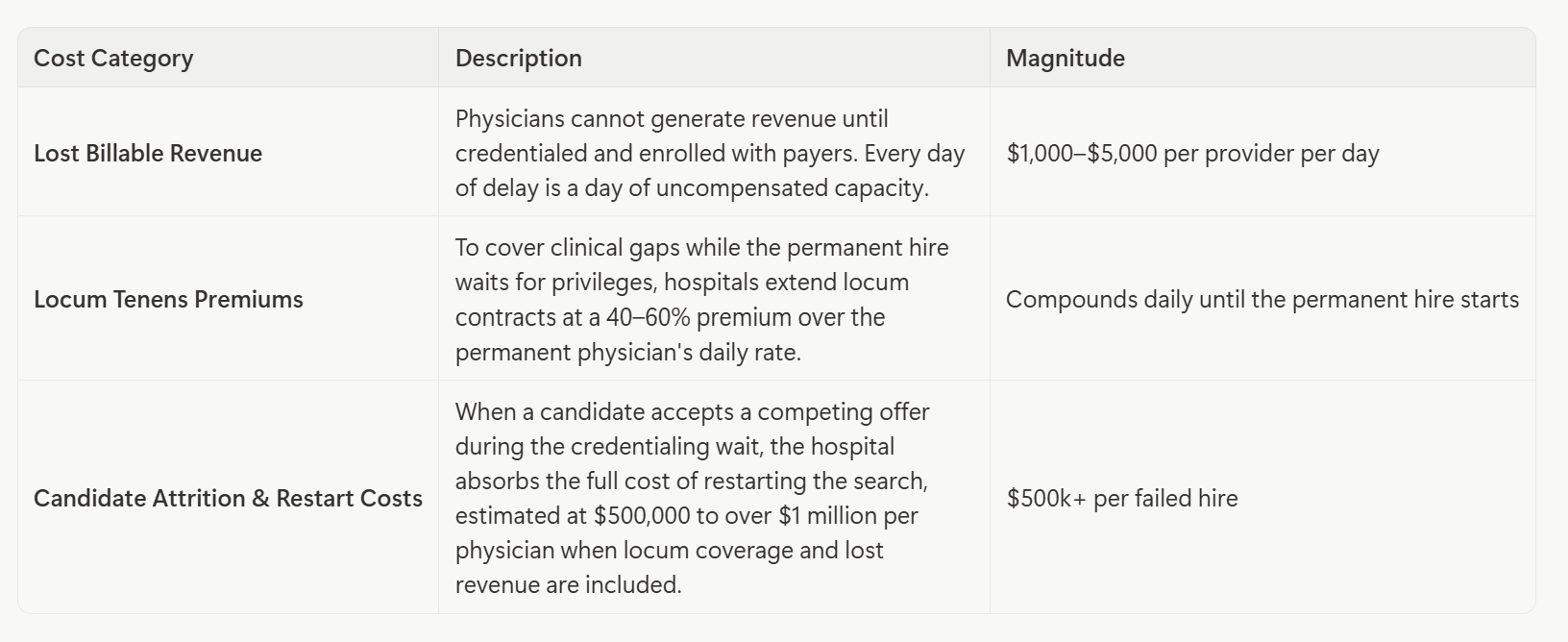
What makes this cost structure particularly damaging is that it is almost entirely invisible to the people who control the credentialing budget. The revenue loss is absorbed by the clinical department. The locum cost sits in a separate workforce budget. The recruiting restart cost is buried in HR. No single leader sees the full picture, which means no single leader is accountable for fixing it.
The IMLC Contrast: What Fast Looks Like
The credentialing delay problem is thrown into sharp relief when you compare it to what the Interstate Medical Licensure Compact has accomplished on the licensing side of the equation.
Before the IMLC, obtaining a new state medical license was itself a months-long ordeal, a bureaucratic process that routinely took six to twelve months per state. Large staffing agencies built entire credentialing departments around this friction, turning licensing speed into a competitive moat.
The IMLC dismantled that moat entirely. Today, 44 states, the District of Columbia, and Guam participate in the Compact. For the approximately 80% of U.S. physicians who qualify, the average wait time for an IMLC license is just 19 days, and 51% of licenses are issued within a single week.
The contrast is stark. The external licensing infrastructure, which was once the most complex and time-consuming part of onboarding a physician, has been compressed to days. The internal credentialing process, which the hospital controls entirely, still takes months. The bottleneck has not moved to where the market is most competitive. It has stayed exactly where it has always been inside the hospital.
What Losing a Candidate During Credentialing Actually Looks Like
The candidate attrition problem deserves more attention than it typically receives, because it is the most emotionally invisible cost in the equation.
When a physician accepts an offer and enters credentialing, the hospital's recruiting team typically disengages. The file is handed to the medical staff office. The recruiter moves on to the next vacancy. Communication with the candidate becomes infrequent and transactional, limited to status updates only when something is needed.
Meanwhile, the physician is sitting in a professional limbo. They have given notice at their current position or are preparing to. They are managing the anxiety of a major life decision. They are fielding calls from other health systems and agencies who know they are in play. And they are receiving very little reassurance from the organization they just committed to.
This is the window in which candidates are lost. Not because the competing offer is dramatically better. Not because the physician was never genuinely committed. But because the silence and the delay erode confidence in the organization's competence and care. A physician who waits 120 days for a start date and receives three status updates in that time is not just frustrated. They are questioning whether they made the right choice.
The hospitals that retain candidates through credentialing are not necessarily the ones with the fastest processes. They are the ones that maintain deliberate, proactive communication throughout the wait: weekly check-ins, milestone updates, introductions to future colleagues, and a clear timeline with honest expectations.
How High-Performing Organizations Have Solved This
The hospitals winning the physician talent war have stopped treating credentialing as a post-hire administrative function and started treating it as a core component of their competitive recruiting strategy. The operational changes they have made are neither radical nor expensive. They are, however, intentional.
Start Before the Offer. The most impactful change a hospital can make is to begin collecting credentialing documentation at the finalist interview stage rather than after a signed offer. Primary source verification, license checks, and malpractice history review can all be initiated before a contract is executed. This eliminates weeks of lag from the front end of the process.
Run Payer Pre Enrollment in Parallel where possible. Decoupling payer enrollment from hospital privileging and initiating both simultaneously, rather than sequentially, can compress the overall onboarding timeline by 60 days or more. This requires coordination between the medical staff office and the revenue cycle team, but the financial return is immediate.
Invest in Digital Credentialing Infrastructure. Organizations using modernized credentialing and enrollment workflows can move 3.5 times faster than those relying on legacy verification processes, reduce administrative costs by 66%, and accelerate payer enrollment timelines by 2x. The technology exists. The barrier is almost always organizational inertia, not budget.
Assign a Candidate Liaison. Designating a single point of contact, distinct from the medical staff office's verification team, whose sole responsibility is candidate communication during credentialing transforms the experience for the physician. This person does not need to have credentialing expertise. They need to be responsive, proactive, and empowered to give honest timeline updates.
Redesign the Committee Calendar. Monthly credentialing committee meetings are a legacy of a pre-digital era when file preparation was a manual, time-intensive process. Organizations that have moved to bi-weekly or rolling review processes have eliminated one of the most arbitrary and damaging delays in the pipeline without compromising the rigor of the review itself.
The Strategic Imperative
The physician recruiting market has never been more competitive, and the tools available to identify and engage passive candidates have never been more powerful. AI sourcing platforms can identify the right physician in seconds. The IMLC can license them in days. But none of that matters if the hospital's own back office loses the candidate in the 90 days between offer and start date.
Credentialing is not a recruiting problem. It is an operations problem. And like most operations problems, it persists not because it is unsolvable, but because no single leader owns it, no single budget reflects its true cost, and no single dashboard makes the damage visible.
The hospitals that recognize this and engineer their back office for the same urgency they bring to their clinical operations will capture the talent that their slower competitors are leaving stranded in the waiting room.
You cannot fix a 2026 recruiting problem with a 1996 credentialing process.
Rate This Article
Click a star to rate
If any of this resonates — or you want to pressure-test these frameworks against your own data — I'm happy to connect. No pitch, just a conversation.
Schedule a Meeting →