

Why Your Recruitment Budget Is Structured Backwards
Most health systems spend the majority of their physician recruitment dollars on the most expensive, least effective part of the problem. Here is why — and what a better model looks like.
There is a pattern that appears in nearly every regional health system's physician recruitment spend, and it is almost always invisible until someone builds the model. The pattern looks like this: a position opens, internal resources are exhausted within thirty to sixty days, an agency is engaged, a locum is placed, and the search for a permanent hire continues in parallel, sometimes for months, sometimes for years. By the time a permanent physician is credentialed and productive, the system has spent two to four times what a proactive recruitment strategy would have cost.
The problem is not that health systems are spending too much on physician recruitment. The problem is that they are spending it in the wrong sequence, on the wrong interventions, at the wrong moment in the vacancy lifecycle.
The 80/20 Inversion
In a well-structured recruitment budget, the majority of spend should be concentrated on the front end of the problem: pipeline development, employer brand, community relationships, and direct outreach to candidates before a position is open. This is the part of recruitment that is measurable, scalable, and compounding. Each relationship built today reduces the cost and time of the next hire.
In practice, most health system recruitment budgets are inverted. The majority of spend lands at the back end of the vacancy lifecycle, after the position has been open long enough to create operational pressure. At that point, the system's negotiating leverage is gone. The agency knows the position is urgent. The locum rate reflects that urgency. And the permanent search, now running under time pressure, is more likely to produce a suboptimal match that results in early attrition, restarting the cycle.
The table below illustrates the cost difference between a reactive and a proactive recruitment model for a single primary care physician vacancy in a mid-sized regional system:
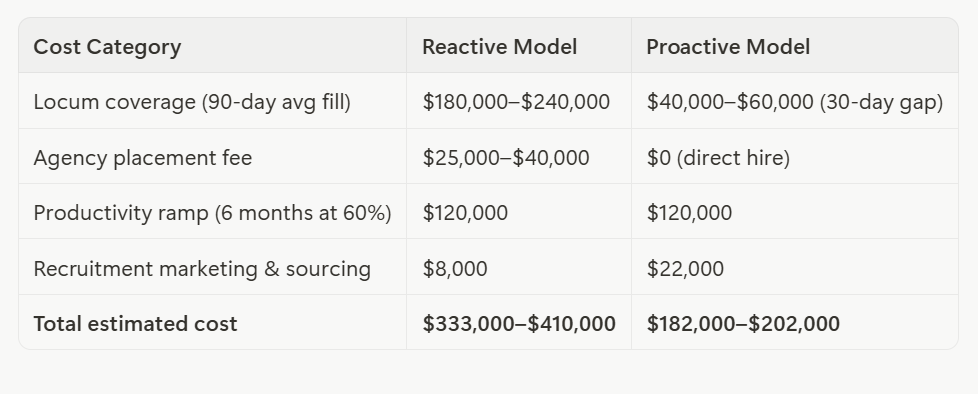
The proactive model spends more on sourcing and marketing (the front-end investment) but eliminates or dramatically reduces the two largest cost categories: locum coverage and agency fees. The net result is a total cost that is 40 to 55 percent lower, with a shorter vacancy period and a higher-quality hire.
Where the Budget Actually Goes
To understand why recruitment budgets are structured backwards, it helps to trace where the money flows in a typical reactive cycle.
Locum premiums represent the single largest line item in most health system recruitment spend, yet they rarely appear in the recruitment budget at all. They sit in the clinical operations or staffing budget, invisible to the CFO reviewing recruitment ROI. This accounting separation is one of the primary reasons the true cost of a physician vacancy is systematically underestimated. When locum spend is excluded from the recruitment cost calculation, the apparent cost of a proactive recruitment investment looks high relative to a baseline that is artificially low.
Agency placement fees are the second major cost category, typically ranging from $25k to $75k. The agency fee is not inherently unreasonable. It reflects the cost of building and maintaining the candidate relationships that the health system chose not to invest in. It is, in effect, the price of not having a proactive strategy.
Administrative burden is the third cost category that rarely appears in recruitment budget analyses. Every reactive search consumes significant time from medical staff coordinators, credentialing teams, department chiefs, and CMO offices. When that time is quantified at fully-loaded labor rates, it typically adds $15,000 to $30,000 to the cost of a single vacancy, before a single dollar of agency or locum spend is counted.
The Compounding Cost of Attrition
The reactive model does not just cost more per hire. It produces worse hires, which cost more over time.
A physician recruited under time pressure (because the department is short-staffed and the locum bill is climbing) is more likely to be a candidate who was available quickly rather than a candidate who was the best fit for the role, the community, and the culture. Early attrition rates for reactive hires run materially higher than for candidates who were recruited through a deliberate, relationship-based process. When a physician leaves within the first two years, the full recruitment cycle begins again, with the added cost of the failed placement.
The data on this is consistent across health system types. Physicians who were recruited through proactive outreach, where the health system initiated contact before the candidate was actively searching, report higher satisfaction scores at 12 months, higher intent to stay at 24 months, and lower early attrition rates than physicians recruited through reactive agency searches. The mechanism is straightforward: a candidate who was sought out feels valued in a way that a candidate who responded to a job board posting does not.
What a Rebalanced Budget Looks Like
Restructuring a physician recruitment budget is not primarily a financial exercise. It is a sequencing exercise. The goal is to shift spend from the back end of the vacancy lifecycle, where leverage is low and costs are high, to the front end, where investment compounds over time.
A rebalanced recruitment budget typically has three components that are absent or underfunded in most reactive models:
A maintained candidate pipeline. This means active relationships with physicians at the resident and fellow level, with physicians in the community who may not be actively searching, and with physicians who have expressed interest in the past but were not ready to move. Maintaining this pipeline requires dedicated recruiter time and a CRM system, but the cost is a fraction of a single agency placement fee.
An employer brand investment. Physicians research health systems before they apply. They read reviews, talk to colleagues, and evaluate the organization's reputation for clinical quality, administrative burden, and leadership. A health system with a strong employer brand attracts candidates at lower cost and retains them at higher rates. This investment is typically underfunded because its returns are diffuse and long-term, exactly the kind of investment that gets cut in a reactive budget cycle.
A proactive outreach function. Rather than waiting for candidates to apply, a proactive recruitment model involves direct outreach to physicians who match the profile of a future vacancy, before that vacancy exists. This requires knowing, at any given time, which positions are at elevated attrition risk (which is exactly what a physician sentiment intelligence program provides) and having the recruiter capacity to act on that intelligence before the position opens.
The CFO Conversation
The most effective way to reframe a physician recruitment budget is to present it as a capital allocation decision rather than an operating expense. The question is not "how much should we spend on recruitment?" The question is "what is the return on a $50,000 investment in proactive pipeline development relative to a $50,000 investment in reactive agency fees?"
When the full cost of a vacancy is modeled, including locum spend, agency fees, productivity ramp, and administrative burden, the ROI on proactive recruitment investment is typically three to five times higher than the ROI on reactive spend. That is a board-level argument, and it is one that most health system CFOs have never been presented with, because the data to make it has never been assembled in one place.
That is the conversation worth having. And it starts with understanding where the budget is actually going.
Rate This Article
Click a star to rate
If any of this resonates — or you want to pressure-test these frameworks against your own data — I'm happy to connect. No pitch, just a conversation.
Schedule a Meeting →